,%20Richard%20Schiff%20(Bohr),%20Damien%20Molony%20(Heisenberg)_Copenhagen_07606_credit%20Marc%20Brenner.jpg)
In 1941, the physicist Werner Heisenberg, best known for formulating his uncertainty principle, visited his mentor Niels Bohr in occupied Denmark. The purpose of that meeting remains mysterious and, even with access to the later letters of the two men, their recollections of what took place differ considerably. At the heart of the matter lies the failure of Germany’s efforts to develop a nuclear weapon and Bohr’s role in the Allies’ success in this endeavour. Questions of patriotism and the moral neutrality of scientific inquiry are explored in the context of the individual’s broader ethical responsibility to humankind, set against the temptations of personal ambition. These are complex issues, and coming to terms with them is not made easier by the fact that the scientific territory itself remains opaque to most of us. Michael Frayn’s play attempts to render the physics more accessible, while also reflecting some of its underlying principles. As Frayn observes in the programme notes, “If Heisenberg’s principle is right, then we can never have absolute knowledge of the physical world. And I think there is a similar theoretical barrier to ever knowing what people are thinking, and what their intentions and motives are.” This idea is woven into the structure of the drama, where certainty proves elusive and truth remains unstable. The challenge for the audience is heightened, however, by the suggestion that Bohr and Heisenberg appear as spirits, revisiting their encounter in multiple, conflicting versions, while the narrative moves fluidly backwards and forwards through time. Such devices demand careful attention from theatregoers. The inclusion of Bohr’s wife, Margrethe, as a voice of clarity and scepticism offers some guidance, yet the play remains an intellectually demanding experience. It is a densely written work, and a single evening in the theatre can do little more than stimulate a desire for further reflection and study of the text. As Heisenberg, Damien Molony delivers a compelling performance, handling the intricate dialogue with assurance and conviction. His intensity lends a nice clarity to the character’s inner conflict. By contrast, Richard Schiff as Bohr appears less secure with the material, his hesitations occasionally obscuring the already challenging text. Alex Kingston, however, brings welcome precision and grounded authority to Margrethe, capturing both her practicality and her sharp, questioning intelligence. Overall, the production grapples bravely with profound and difficult ideas, even if it does not always succeed in making them fully accessible. Its intellectual ambition is undeniable, and while it may at times feel elusive, it leaves a lasting impression as a thoughtful exploration of science, morality, and the limits of human understanding.
Rated: ★★★★
Reviewed by J.C.
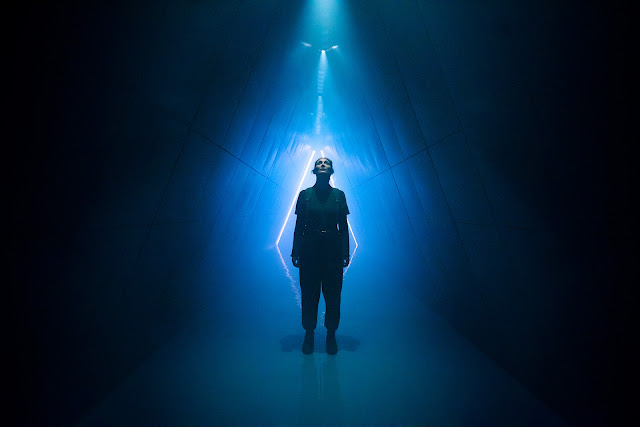
Photo by Marc Brenner
When, Where, Getting there:
,%20Richard%20Schiff%20(Bohr),%20Damien%20Molony%20(Heisenberg)_Copenhagen_07606_credit%20Marc%20Brenner.jpg)



,%20Julian%20Ovenden%20(Charles%20Nichols)%20-%20by%20Manuel%20Harlan%20(2).jpg)

%20and%20Ruby%20Ashbourne%20Serkis%20(Flora%20Crewe)%20in%20Indian%20Ink%E2%80%9305243_credit%20Johan%20Persson.jpg)
%20%C2%A9%20The%20Trustees%20of%20the%20British%20Museum.jpeg)
