
The subtitle of Romans is "a novel," and it is likely no accident that the family name of its characters is a homophone of the literary genre romance. However, despite the play’s Dickensian opening and its quest-driven narrative, it is probably more accurately described as an allegory. Reminiscent of The Brothers Karamazov, the story centres on three brothers who attempt to define themselves within a patriarchal society that is beginning to collapse. Marlow represents business and politics as a medium for the expression of masculinity and control, while Jack, his mirror image, symbolises the fields of art and religion. Marlow is portrayed as a figure similar to Elon Musk, whereas Jack’s life, before he becomes a cult leader in the style of Jim Jones, seems modelled on that of F. Scott and Zelda Fitzgerald. Shaped by a traumatic childhood that distorts their sense of purpose and masculinity, both of these siblings strive to establish their identity through an overweening ambition and a domination of others. Caught between these two toxic expressions of male identity is Edmund, the youngest brother. He struggles with a fractured sense of self, adopting various identities and eventually retreating into an animalistic persona. His journey seems to be marked by uncertainty, confusion and a desire for authenticity, though the play never fully explores that story. In fact, although Romans presents an absorbing study of what has been called the current crisis of masculinity, its narrative focus on Jack creates an imbalance. Marlow is reduced to a caricature, and Edmund, perhaps the most intriguing of the three brothers, remains largely in the background. It may be understandable that playwright Alice Birch would choose to concentrate on Jack, the artist who shares her vocation, but this emphasis weakens the architecture of the work. A lengthy section in the second act, set within Jack's cult, is both amusing and entertaining, yet it occupies an amount of stage time that feels disproportionate to its importance in the overall narrative. The scene has considerable theatrical flair but it diverts attention from the broader thematic arcs established earlier in the play. Thus, while playwright Birch successfully draws the audience into her characters' lives and the world they inhabit, the allegorical structure she employs does not always feel fully realised. As the three brothers, Oliver Johnstone, Kyle Soller, and Stuart Thompson all deliver strong performances, and they are skilfully supported by a capable and committed cast. Director Sam Pritchard maintains a steady pace throughout, and although the production is long, it remains engaging from beginning to end. Ultimately, Romans is a thought-provoking and ambitious production, filled with compelling ideas and striking moments.
Rated: ★★★★
Reviewed by J.C.
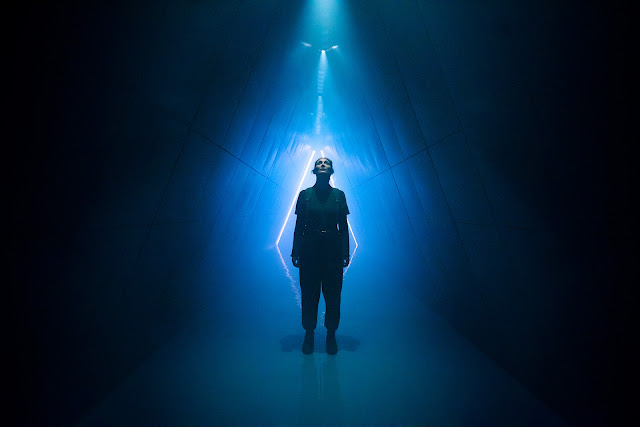
Photo by Marc Bonner
When, Where, Getting there:



,%20Julian%20Ovenden%20(Charles%20Nichols)%20-%20by%20Manuel%20Harlan%20(2).jpg)

%20and%20Ruby%20Ashbourne%20Serkis%20(Flora%20Crewe)%20in%20Indian%20Ink%E2%80%9305243_credit%20Johan%20Persson.jpg)

